
Some employers round clock-in and clock-out times before calculating paid hours. Under the federal rule, a common method rounds each punch to the nearest quarter hour: a punch up to seven minutes past a quarter-hour mark rounds back, while one eight minutes past rounds forward. This is often called the “7-minute rule.” It is not permission to remove seven minutes from every shift. Over time, the method must not leave employees improperly paid for hours they actually worked.
This guide shows how to check the arithmetic on a time card and what to look for when the rounded total differs from your actual work time. Federal rules are the starting point; a state rule or another requirement may affect your situation.
What does the federal time clock rounding rule allow?
29 CFR 785.48 discusses recording start and stop times to the nearest five minutes, one-tenth of an hour (six minutes), or quarter hour (15 minutes). The regulation says such a practice is accepted for federal enforcement purposes when it is used in a way that does not, over a period of time, result in employees being improperly compensated for time they actually worked.
An employer does not have to use rounding or even use a time clock. A punch is also not always the exact moment work begins or ends. For example, arriving early and clocking in without doing any work is different from starting assigned duties before the scheduled shift. The question is how much compensable work was performed and recorded, not merely what time appears on the schedule.
How does the 7-minute rule work?
With rounding to the nearest 15 minutes, each hour is divided into marks at :00, :15, :30 and :45. The punch is moved to the nearest mark. For whole-minute punches, seven minutes after a mark rounds back to it; eight minutes after a mark rounds forward to the next one.
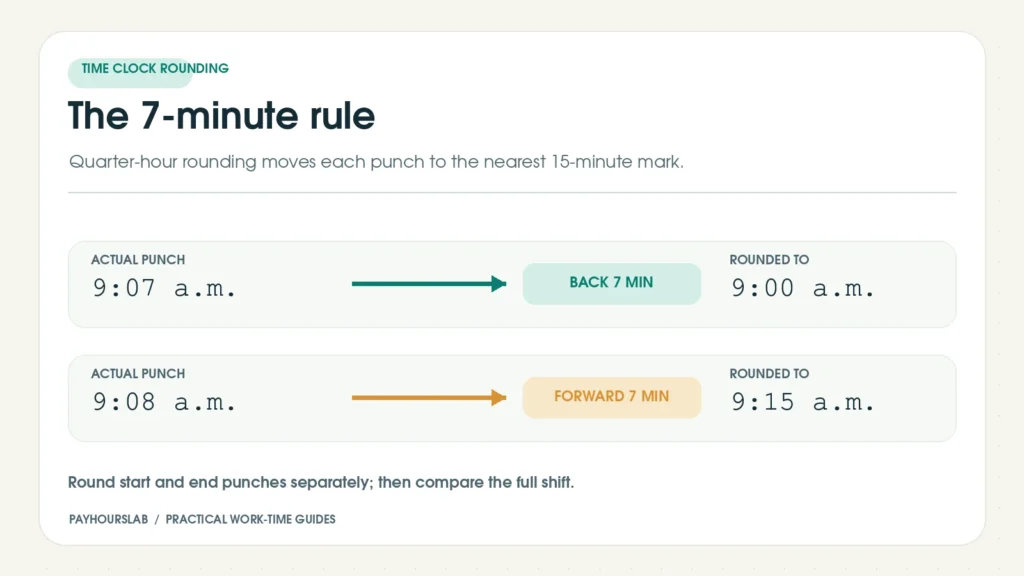
| Actual punch | Nearest quarter hour | Change to that punch |
|---|---|---|
| 9:07 a.m. | 9:00 a.m. | 7 minutes earlier |
| 9:08 a.m. | 9:15 a.m. | 7 minutes later |
| 9:22 a.m. | 9:15 a.m. | 7 minutes earlier |
| 9:23 a.m. | 9:30 a.m. | 7 minutes later |
For instance, rounding a start time of 9:07 a.m. back to 9:00 a.m. adds seven minutes to the recorded duration if the end stays the same. Rounding an end time of 5:07 p.m. back to 5:00 p.m. removes seven minutes. Compare the complete shift, then compare the pattern across multiple shifts.
A five-day example you can check
Suppose the following punches represent the beginning and end of work on five days. This simplified example leaves meal periods out of the arithmetic so that the rounding is easy to see. It does not establish whether a particular workplace must provide a break.
| Day | Actual punches | Actual duration | Rounded punches | Rounded duration | Difference |
|---|---|---|---|---|---|
| Monday | 9:07 a.m.–5:07 p.m. | 8:00 | 9:00 a.m.–5:00 p.m. | 8:00 | 0 minutes |
| Tuesday | 9:08 a.m.–5:08 p.m. | 8:00 | 9:15 a.m.–5:15 p.m. | 8:00 | 0 minutes |
| Wednesday | 9:07 a.m.–5:08 p.m. | 8:01 | 9:00 a.m.–5:15 p.m. | 8:15 | +14 minutes |
| Thursday | 9:08 a.m.–5:07 p.m. | 7:59 | 9:15 a.m.–5:00 p.m. | 7:45 | −14 minutes |
| Friday | 9:02 a.m.–5:02 p.m. | 8:00 | 9:00 a.m.–5:00 p.m. | 8:00 | 0 minutes |
| Total | Five shifts | 40:00 | Five rounded shifts | 40:00 | 0 minutes |
The calculations are easier to audit in minutes: Wednesday’s actual duration is 481 minutes and its rounded duration is 495 minutes. Thursday’s are 479 and 465 minutes. Across the five days, both columns total 2,400 minutes.
How to compare your punches with your pay record
- Record the times you actually worked. Keep the original clock punches if available, and note any work before clock-in, after clock-out or during a scheduled break that the punches do not show.
- Calculate each shift before rounding. Find the duration from start to end and subtract only a genuinely unpaid break. The time card calculator can total seven days from clock times and unpaid break minutes. It uses the entered times; it does not apply an employer’s rounding policy.
- Reproduce the employer’s method separately. Check whether punches are rounded to five, six or 15 minutes, and whether the same method is applied to starts and stops. Do not assume the policy from a single paycheck.
- Compare totals in minutes. A payroll figure such as 7.75 hours means seven hours and 45 minutes. It does not mean seven hours and 75 minutes. Note each difference and the total over several pay periods.
- Check the workweek boundary. If you are a covered, nonexempt employee, hours actually worked over 40 in your employer’s defined workweek may affect federal overtime pay. A pay period and a workweek are not necessarily the same thing.
For one shift, the work hours calculator shows the entered duration in hours and minutes and in decimal hours. Once you have checked a week’s compensable hours, the overtime calculator can illustrate a basic federal pay estimate. Neither calculator decides whether a rounding practice complies with the law.
Warning signs that deserve a closer look
- Start punches are routinely moved later and end punches are routinely moved earlier, with no corresponding rounding that benefits the employee.
- The recorded total repeatedly falls below the time actually worked, especially when the missing minutes recur each shift.
- A fixed meal deduction remains on the time card even when the employee worked through that period.
- Work before or after a scheduled shift is excluded simply because the schedule says otherwise.
These observations call for a check of the underlying records and circumstances; a single discrepancy does not establish a legal violation. If a meal period is involved, read Are Breaks Paid? before treating it as unpaid. Federal guidance generally distinguishes short paid rest breaks from genuine meal periods during which the worker is completely relieved of duties.
If your totals do not match, keep the original punches, your own dated notes, pay statements and the employer’s stated rounding policy. Ask payroll how the paid total was calculated and use the employer’s process to correct missing work time. For an unresolved question, consult the applicable state labor agency or the U.S. Department of Labor’s Wage and Hour Division.
Frequently asked questions
Is the 7-minute rule required by federal law?
No. It is a common way to describe rounding to the nearest quarter hour, not a requirement that employers round time. Federal regulations also discuss other intervals. A method must be assessed by how it affects compensation for time actually worked over a period of time.
Can an employer always round down?
A practice that consistently removes worked time raises a different issue from neutral rounding to the nearest interval. The federal regulation accepts rounding only when its application does not, over time, result in employees being improperly compensated for their actual work.
Does clocking in early always add paid time?
Not necessarily. Under the federal time-clock regulation, an early punch may be disregarded when an employee arrives before the regular start but does no work. If work is performed, the actual duties and time matter. Keep a record of work that the time card does not capture.
Does the PayHoursLab time card calculator round punches?
No. It calculates durations from the start and end times you enter, subtracts the unpaid break minutes you enter and totals the resulting minutes. Use it to create an unrounded comparison, then check the employer’s rounding separately.
Sources and methodology
Reviewed October 7, 2026. The federal rounding and clock-punch explanation is based on 29 CFR 785.48 and the U.S. Department of Labor’s FLSA Hours Worked Advisor. Recordkeeping context comes from Fact Sheet #21; the federal overtime baseline comes from Fact Sheet #23. The five-day table is an arithmetic example created for this guide, not a payroll record or a finding about a particular employer. Check current federal and state requirements for your circumstances.